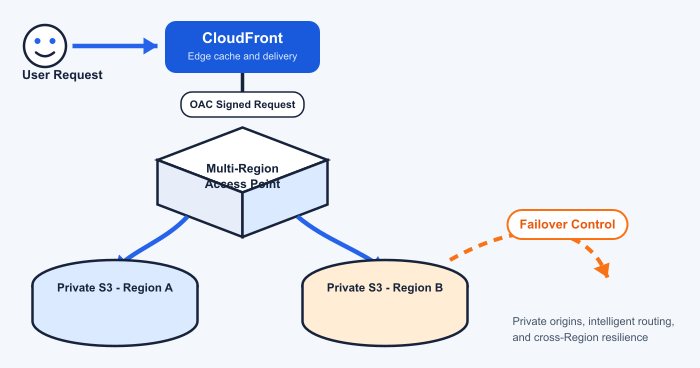
When a static website, software download service, or media platform needs regional resilience, a common design is to copy objects into Amazon S3 buckets in multiple AWS Regions. The difficult part is not creating the extra buckets. It is keeping origin access private while coordinating routing, replication, cache behavior, and failover without turning the architecture into several disconnected control planes.
CloudFront Origin Access Control (OAC) support for Amazon S3 Multi-Region Access Points (MRAPs) makes that design easier to organize. Visitors continue to request content through CloudFront. CloudFront signs origin requests with AWS Signature Version 4, while the MRAP provides a global endpoint in front of private S3 buckets across Regions. For planned maintenance, disaster-recovery exercises, or a regional disruption, MRAP failover controls can shift new origin traffic toward another Region.
This does not make resilience automatic. Replication, object consistency, permissions, caching, encryption keys, monitoring, and rollback still need to be designed together.
What CloudFront, OAC, and an S3 Multi-Region Access Point Each Do
CloudFront handles content delivery and edge caching. When an object is already available at an edge location and remains fresh, CloudFront can return it without contacting S3. An origin request is made only when the object is missing, expired, or otherwise requires revalidation.
OAC handles identity and request signing between CloudFront and the origin. It allows an S3 origin to remain private and accept signed requests from an authorized CloudFront distribution instead of requiring public read access.
An S3 Multi-Region Access Point provides one global access point for S3 buckets in multiple Regions. Rather than making an application select an individual regional endpoint, the MRAP routes requests over the AWS global network toward an active bucket. Its failover controls can also change the routing status of Regions during maintenance or an incident.
The responsibilities are separate: CloudFront manages edge delivery and caching, OAC authenticates the private origin request, and MRAP provides multi-Region S3 routing and failover control.
How a Request Travels Through the Architecture
Consider a request for /downloads/app.zip:
The visitor requests a domain name connected to a CloudFront distribution.
CloudFront checks its edge cache and returns a fresh cached object immediately.
On a cache miss, CloudFront uses the attached OAC to sign the origin request with SigV4.
CloudFront sends the signed request to the S3 Multi-Region Access Point endpoint.
The MRAP selects an active Region according to its routing status and the AWS network path.
S3 evaluates the signature, MRAP policy, bucket policy, and any applicable KMS key policy.
After authorization, S3 returns the object to CloudFront.
CloudFront caches the response and delivers it to the visitor.
The visitor never needs public access to an individual bucket. Knowing a bucket name should not be enough to bypass CloudFront and retrieve a private object directly.
What Changes Compared with a Single-Region S3 Origin
In a single-Region design, CloudFront normally points to one S3 bucket. The configuration is straightforward, but origin availability and data placement depend on that Region. Regional resilience requires extra replication, routing, permission, monitoring, and recovery procedures.
With an MRAP, CloudFront points to a global endpoint backed by buckets in multiple Regions. A failover exercise can change MRAP routing status without replacing the CloudFront origin domain during the incident. The origin buckets can remain private because OAC signs the requests.
However, MRAP routing does not copy objects. If the selected bucket does not contain the requested version, intelligent routing cannot manufacture the missing data. S3 Cross-Region Replication, versioning, deletion behavior, encryption permissions, and recovery objectives must be configured separately.
Workloads That Can Benefit from This Design
Global Software and Large-File Distribution
Installers, patches, firmware, and data packages are often large and requested from many locations. CloudFront reduces repeated origin downloads through edge caching, while an MRAP gives cache-miss requests a consistent multi-Region origin endpoint.
Resilient Static Websites and Front-End Assets
Organizations with stricter availability targets can replicate HTML, JavaScript, CSS, fonts, and images to several Regions. CloudFront serves cached content normally, while the MRAP provides another origin path when a Region is placed into failover.
Media, Gaming, and Content Platforms
Video artwork, game packages, documentation archives, and other read-heavy objects are well suited to CDN caching. Multi-Region S3 copies reduce dependence on one origin Region, although performance should still be measured with real cache-miss traffic.
Systems with Data-Boundary Requirements
MRAP routing is not, by itself, a data-residency compliance solution. Teams must decide which Regions may store each object, which Regions may serve it, where logs are retained, and whether replication is permitted by policy and regulation.
Four Permission Layers That Must Agree
1. CloudFront Distribution and OAC
Create or select an OAC and associate it with the CloudFront origin that uses the MRAP. In most private-origin designs, CloudFront should sign origin requests. Forwarding a viewer's Authorization header unchanged is different behavior and should be used only when the application explicitly requires it.
The origin must use the correct MRAP endpoint format. Treat it as an S3 origin supported by OAC rather than exposing a regional bucket as a public custom origin.
2. MRAP Access Policy
An MRAP has its own access policy. It must allow the required S3 actions for the intended principal and resources. A correct bucket policy alone does not compensate for an MRAP policy that denies or omits the request. A download distribution normally needs object-read permissions, not unrestricted bucket administration.
3. Bucket Policies
Every bucket behind the MRAP needs a compatible bucket policy. When authorizing CloudFront, scope access to the intended distribution where the supported condition model allows it. Avoid public principals or permissions that unintentionally permit direct bucket access.
S3 Block Public Access should remain enabled unless a separately reviewed requirement says otherwise. After configuration, test both the approved CloudFront path and an unapproved direct S3 path.
4. KMS Key Policies
If objects use server-side encryption with AWS KMS keys, S3 permission alone is not sufficient. The relevant principals must also be able to use the keys in every Region that may serve or replicate the data.
A design can work in Region A and fail after switching to Region B because the replica exists but the Region B KMS policy is incomplete. Encryption must be included in normal and failover tests.
Replication Determines Whether Failover Returns the Right Object
An MRAP determines where a request goes. S3 replication determines what is present when it arrives.
Before relying on regional failover, define:
which source and destination buckets participate in replication;
whether S3 Versioning is enabled;
how existing objects are handled;
whether delete markers and object deletions are replicated;
how KMS-encrypted objects are replicated and decrypted;
the acceptable replication time objective;
how failed or delayed replication is detected;
which Region accepts writes during normal operation and after failover.
For read-heavy static content, a controlled release process is safer than overwriting objects in place. Upload versioned filenames such as app.20260824.js, confirm that replicas are available, and only then update the HTML or manifest that references them. Keeping the previous release for a defined period also makes rollback easier.
For write-heavy workloads, conflict resolution is more complicated. Do not assume that two writable buckets behind one global endpoint behave like a strongly consistent multi-Region database. The application must have a clear write topology and recovery procedure.
Cache Behavior and Failover Must Be Tested Together
CloudFront caching can make an origin failover appear to have had no effect. If an object remains valid in an edge cache, CloudFront continues serving that copy. The MRAP only participates when CloudFront needs to contact the origin.
A useful disaster-recovery test covers two paths:
Cache hits: already cached objects should continue to be delivered correctly.
Cache misses: new, expired, or carefully invalidated test objects should be retrieved from the intended active Region.
Avoid invalidating /* simply to prove that failover works. A global invalidation can create a wave of origin requests, lower the cache-hit ratio, and concentrate load on the Region that has just become active. Use a dedicated test prefix or invalidate a small set of controlled objects instead.
TTL decisions also affect recovery behavior. Long TTLs protect the origin during a disruption but delay the visibility of an updated object. Short TTLs make updates visible sooner but increase origin dependence. Choose cache settings according to the release process and recovery objectives rather than applying one TTL to every asset.
A Practical Configuration Sequence
Step 1: Prepare Regional Buckets
Create buckets in the required Regions, enable the appropriate public-access blocks, configure versioning, and decide how objects will be encrypted. Do not copy production data until the allowed Regions and retention rules are clear.
Step 2: Configure Replication
Create replication rules for the required prefixes or tags. Verify IAM roles, KMS permissions, replication metrics, and the treatment of existing objects. Upload a controlled test object and confirm that the expected version reaches every intended bucket.
Step 3: Create the MRAP
Associate the regional buckets with an S3 Multi-Region Access Point. Apply an MRAP policy that permits only the required operations. Record its alias and endpoint information for the CloudFront origin configuration.
Step 4: Configure CloudFront and OAC
Create an OAC or reuse an appropriate one, attach it to the MRAP origin, and configure cache and origin-request policies. Forward only the headers, cookies, and query strings that the origin actually needs, because unnecessary cache-key variation reduces the cache-hit ratio.
Step 5: Align Policies
Review the CloudFront distribution, OAC behavior, MRAP policy, bucket policies, IAM permissions, and KMS key policies as one authorization chain. A single missing permission can surface as a generic 403 AccessDenied, so document the expected principal and resource at every hop.
Step 6: Test Normal and Failure Paths
Confirm normal downloads, cache hits, cache misses, range requests where relevant, and direct-access denial. Then perform a controlled failover exercise, observe replication health and origin traffic, and execute the documented rollback.
Monitoring and Troubleshooting
Monitor more than the CloudFront viewer error rate. A complete view may include:
CloudFront requests, cache-hit ratio, origin latency, and 4xx/5xx responses;
MRAP routing state and failover changes;
S3 replication latency, pending operations, and failed replication;
S3 access logs or CloudTrail data events where appropriate;
KMS authorization failures;
synthetic requests for both cached and deliberately uncached test objects.
If CloudFront returns 403 AccessDenied, check the authorization chain in order: OAC attachment, origin endpoint, MRAP policy, bucket policy, object ownership, and KMS key policy. If only one Region fails, compare that Region's bucket and key policies with the working Region.
If users receive an old object after failover, check CloudFront TTL and cache status before assuming that MRAP routed incorrectly. Then confirm that the target bucket contains the expected version and that replication is complete.
If origin latency changes, separate viewer-to-edge performance from edge-to-origin performance. CloudFront can still serve cached objects quickly even when a cache-miss path has become slower.
Pre-Launch Checklist
Content and Replication
Two or more regional buckets are associated with the MRAP.
Critical objects have been replicated and their versions or checksums match expectations.
Deletion, overwrite, rollback, and existing-object behavior have been tested.
Replication delay and failure have monitoring and alerting.
Permissions and Security
Every origin bucket remains private.
The OAC is attached to the correct CloudFront origin.
MRAP, bucket, IAM, and KMS policies are consistent.
Unauthorized direct requests to a bucket or MRAP are denied.
Logs do not expose sensitive request data unnecessarily.
CloudFront and Recovery
Cache policies match the content update process.
Unneeded cookies, headers, and query strings are excluded from the cache key.
Tests cover both cache-hit and cache-miss behavior.
Failover and failback procedures are documented.
A rollback decision point and responsible owner are defined.
The exercise observes CloudFront, MRAP, S3 replication, and application metrics together.
Frequently Asked Questions
Do I Still Need CloudFront After Using an MRAP?
Usually, yes, when the workload needs public web delivery or large-scale content distribution. MRAP provides global access and routing among S3 Regions. CloudFront provides edge caching, viewer-facing HTTP delivery, custom domains, TLS, and edge security capabilities. They solve different layers of the problem.
Does OAC Automatically Make an S3 Bucket Private?
No. OAC signs CloudFront origin requests, but bucket exposure is still controlled through S3 Block Public Access, bucket policies, ACL settings, and related permissions. Test that the CloudFront path succeeds and direct unapproved access fails.
Does MRAP Guarantee Zero Data Loss?
No. MRAP is a routing layer, not synchronous replication or a multi-Region database consistency guarantee. Data protection depends on versioning, replication, backups, encryption, and application write design.
Why Do Users Still See Old Content After a Regional Switch?
First check the CloudFront cache status and TTL. Edge locations may still hold a valid cached response. Next, verify that the destination bucket received the expected object version through replication.
Will This Architecture Increase Cost?
It can add multi-Region storage, replication, MRAP data-routing, CloudFront request and transfer, logging, monitoring, and KMS request costs. The result depends on Regions, traffic distribution, object size, cache-hit ratio, replication volume, and optional services. Use current AWS pricing information and real workload logs for an estimate instead of relying on a single per-GB number.
Conclusion
CloudFront OAC support for S3 Multi-Region Access Points removes an awkward permission boundary from multi-Region static-content architectures. CloudFront remains responsible for edge caching and delivery, OAC gives origin requests a verifiable identity, and MRAP places multiple regional S3 buckets behind one global endpoint with routing and failover controls.
A successful deployment requires more than confirming that a page loads. Verify that direct access is denied, replicas arrive within the required time, cache misses reach the intended Region, encrypted objects work in every active Region, monitoring detects replication problems, and the team can complete and reverse a controlled failover.
CloudFlew provides CDN services based on Amazon CloudFront. Before planning multi-Region content delivery, collect user geography, monthly traffic, request volume, cache-hit ratio, recovery objectives, and data-placement requirements. Then compare current product information and service terms with the architecture the workload actually needs.