CDN and SSL Certificate Synergy: Achieving Both Encryption and Acceleration
Last year, a client's website became noticeably slower after switching to HTTPS. "Isn't HTTPS supposed to be more secure? Why is it slower?" They had left all TLS handshake and encryption work to their origin server, pushing CPU usage up to 80%.
This is the most common misunderstanding about HTTPS acceleration: HTTPS itself isn't slow. The deployment is.
01 The Core Problem
HTTPS is slower than HTTP primarily because of the TLS handshake. When a user visits an HTTPS site, the browser and server complete a cryptographic negotiation — taking 2-3 round‑trip times (RTT) — before any data can be transmitted. On poor networks, this delay is amplified.
The other issue is encryption overhead. Every packet over HTTPS needs to be encrypted and decrypted. If your origin server handles everything alone, CPU becomes the bottleneck.
The dilemma: Security demands encryption, encryption demands computation, and computation demands resources. Deployed wrong, HTTPS hurts speed.
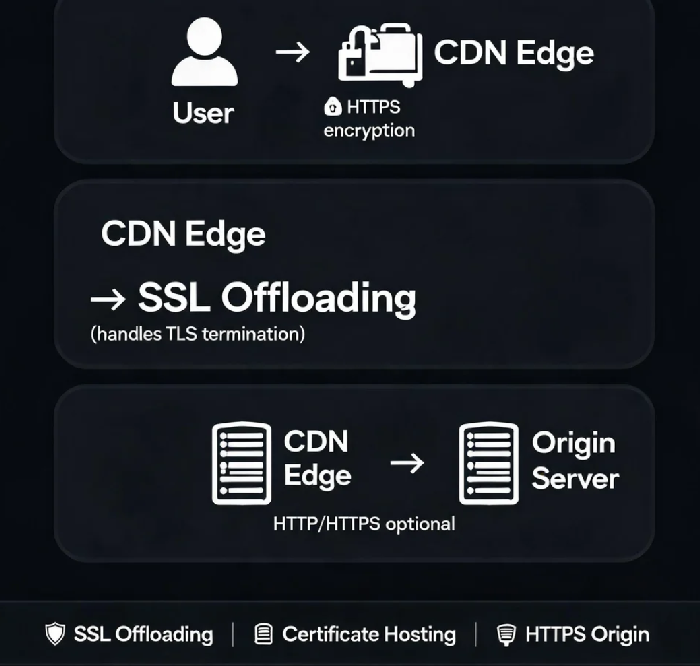
The solution: A CDN + SSL certificate synergy. Let the CDN handle TLS termination. Let the origin serve business logic without the cryptographic workload.
02 Why a CDN Makes HTTPS Faster
CDN edge servers are geographically distributed and close to users. Instead of users connecting directly to a distant origin, they connect to a nearby edge node. When SSL offloading is enabled, the edge node terminates the TLS connection — it handles encryption/decryption and sends plaintext requests over HTTP to the origin.
The benefits:
Reduced latency: The TLS handshake happens between user and edge, not user and origin. Network round trips are shorter.
Lower origin CPU load: The origin only processes business logic, not cryptographic operations. One client's CPU dropped from 80% to 30%, and page load times improved.
Faster certificate validation: OCSP stapling reduces certificate validation time by 30-50%.
03 Certificate Hosting: The Vital Link
An SSL certificate is a digital file issued by a Certificate Authority (CA) that verifies server identity and enables encrypted connections. With certificate hosting, the certificate is managed on the CDN platform and automatically deployed to all edge nodes. When a certificate is about to expire, platforms send reminders 30, 15, and 7 days in advance. With managed hosting, auto‑renewal and auto‑deployment happen without manual intervention.
Certificate types:
| Type | Validation | Best For |
|---|---|---|
| DV (Domain Validation) | Domain ownership only | Personal blogs, small sites |
| OV (Organization Validation) | Business identity verified | Corporate websites |
| EV (Extended Validation) | Rigorous legal verification | Finance, e‑commerce |
Matching rule: The certificate must match the accelerated domain (what users visit). A wildcard certificate (*.example.com) covers www, api, and cdn subdomains, but www.example.com cannot use a wildcard certificate for a different domain.
04 HTTPS Acceleration Best Practices
1. Enable SSL offloading on the CDN – Terminate TLS at the edge. Origin CPU drops, page loads improve.
2. Host certificates on the CDN platform – Automatic renewal and deployment, eliminating "certificate expired" outages.
3. Use OCSP Stapling – This reduces certificate validation time by 30-50% by having the CDN edge cache certificate revocation status.
4. Choose the right certificate type – DV for personal sites, OV for businesses, EV for high‑security use cases.
The Bottom Line
That client eventually hosted their SSL certificate on the CDN platform and enabled SSL offloading. Origin CPU dropped to 30%. Page loads were faster than before.
He said: "I used to be afraid of HTTPS slowing my site. Now I know — HTTPS doesn't have to be slow if you let the CDN handle the heavy lifting."
The core principle: Let the CDN handle cryptography. Let your origin do what it does best — serving your application.