Random Failure Injection and Resilience Testing: Break Things on Purpose to Build Immunity
Last year, a client had a solid high‑availability setup. Multi‑AZ deployment. Read replicas. Circuit breakers. Everything looked solid. Before a big sale, they ran a chaos experiment: they killed a single cache node. It failed gracefully. They declared the system resilient.
Then on sale day, the cache cluster rebalanced itself – a routine operation. The rebalance triggered a “node changed” event. The cache client responded by rebuilding its connection pool. During the rebuild, every request bypassed the cache and hit the database. The database connection pool exhausted. The whole chain collapsed.
They had tested a “fixed node kill.” Real failures are rarely so predictable.
Today, let’s talk about random failure injection and resilience testing. Not the “chaos engineering is cool” intro, but a practical guide: how to break systems randomly, how to measure recovery, and how to build real immunity – not just checklists.
01 Fixed Failures Won’t Find Real Weaknesses
Many teams run chaos experiments on a schedule: “Every Wednesday at 3 PM, kill the order service pod.” The service recovers. The dashboard stays green. Confidence goes up.
But real failures don’t follow a schedule. They happen at 2 AM. They happen to services you never thought to kill. They involve two failures at once. Or a service that doesn’t die – just slows down.
Fixed failure injection validates what you already know. Random failure injection discovers what you didn’t know you didn’t know.
That client tested “cache node dies.” The application degraded to reading from the database. That worked. They never tested “cache node becomes slow.” A slow cache is more dangerous than a dead one – connections don’t fail, but every request blocks for hundreds of milliseconds.
Random failure injection is about simulating the unpredictability of the real world.
02 Failure Types: More Than Just “Stop”
Many people equate failure with “service stops responding.” Real failures are far more varied.
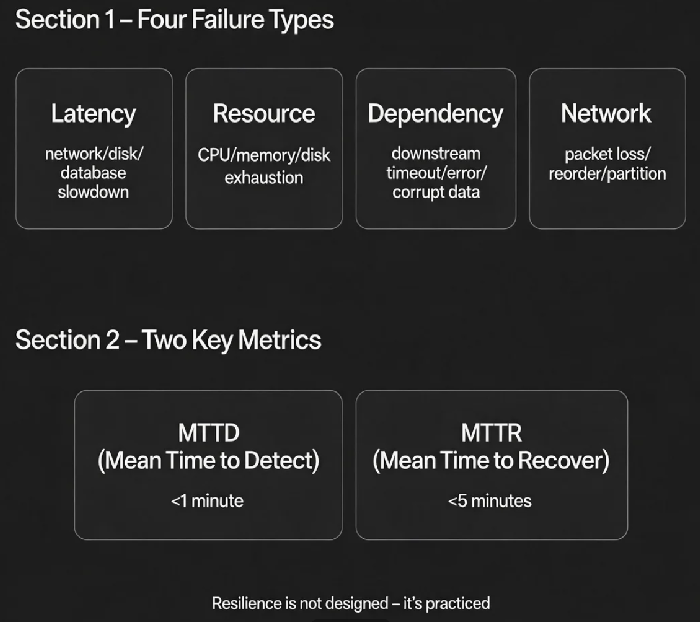
Latency failures: Network delay, slow disk I/O, slow database queries. More subtle than hard failures, harder to detect.
Resource exhaustion: CPU saturates, memory runs out, disk fills, connection pools exhaust. The system is still running but effectively dead.
Dependency failures: Downstream timeouts, malformed responses, wrong status codes, unexpected data formats.
Network failures: Packet loss, reordering, duplication, network partitions. More complex than simple latency.
Configuration failures: Wrong configs loaded dynamically, expired certificates, misapplied rate limits.
After that incident, the client added random latency injection to their tests. When a cache node was delayed by 50‑200ms randomly, they discovered the cache client had no circuit breaker. Thread pools exhausted quickly.
03 Injection Strategy: Random Time, Random Target, Random Type
Resilience testing isn’t a one‑time event. It must be continuous and unpredictable.
Random time: Don’t just run tests on weekday afternoons. Run them at night, on weekends, before sales. System behaviour varies by time.
Random target: Don’t only kill services you think are important. Kill edge services. Kill multiple at once. Kill the service you just declared “non‑critical.”
Random type: Today, inject latency. Tomorrow, drop packets. Next week, spike CPU. Each failure type reveals different weaknesses.
Random combinations: Simultaneous failures – latency + packet loss, CPU spike + disk slowdown, two nodes killed at once. Real failures are rarely singular.
That client turned failure injection into a weekly automated job. Random time, random target, random failure type. After each run, an automated report highlighted which resilience checks failed and which metrics degraded.
04 Blast Radius: Control the Damage
Random failure injection is not a free‑for‑all. Control the impact.
Isolate by service: Practice on non‑critical services first. Only expand to core services after the team is comfortable.
Isolate by traffic percentage: For production experiments, limit impact to 1% of users initially. Grow the blast radius gradually.
Isolate by time window: Set a fault duration – e.g., 60 seconds – after which the system automatically recovers.
State rollback: Capture system state before injection. After the experiment, automatically revert any persistent changes (e.g., terminated instances, altered configs).
Early on, that client accidentally affected 3% of production traffic during a random injection. They added an automatic blast‑radius safety net: when error rates exceed 5%, all failure injection stops immediately and the system rolls back to the last healthy state.
05 Observability: It’s Not About “Did It Fail?” – It’s About “How Fast Did It Recover?”
Resilience testing isn’t about whether the system fails. It’s about what happens after.
MTTD (Mean Time to Detect): How long from fault injection to the first alert? Did monitoring catch it automatically, or did a human notice?
MTTR (Mean Time to Recover): How long from fault injection to full recovery? Was recovery automatic or manual?
Performance during recovery: Which features degraded? How many users were affected? Was any data lost?
Post‑recovery state: After recovery, are there residual issues? Connection leaks? Cold caches? Unclosed file handles?
That client set MTTD and MTTR as the primary success criteria for resilience tests. Target: MTTD < 1 minute, MTTR < 5 minutes. Any release that caused a test to miss these targets was blocked.
06 A Real Story: Random Latency Exposed a Missing Circuit Breaker
A financial client had passed all their fixed‑failure chaos tests. We added random failure injection: on the payment gateway dependency, inject 100‑500ms of random latency.
The first test passed for 10 minutes – then collapsed. The downstream timeout was 3 seconds, so requests didn’t time out. But requests piled up, and the thread pool exhausted.
The fix: reduce the timeout to 500ms and add a circuit breaker. After 5 consecutive slow calls, open the circuit. Return a graceful “system busy” fallback.
The retest ran stably for one hour. MTTR dropped from 15 minutes to 2 minutes. The random latency test had found a weakness that fixed‑failure tests never exposed.
The Bottom Line
Resilience is not designed. It’s practiced.
That client’s ops lead later said: “We used to only test whether the system could survive a failure. Now we know we also have to test how gracefully it fails – and how quickly it recovers. Random failure injection made us think about second‑order effects we never considered.”
How many random failure “vaccines” has your system had? Random latency, random packet loss, random node kills, random CPU spikes. Practice them. Your production system will thank you.